Case Study
VML × ConEdison
Embedding AI into design and engineering workflows at scale, leading two Agile pods for New York's largest utility while building a WCAG-compliant design system and raising AI literacy across cross-functional teams.
Overview
This engagement is about more than UX delivery. Leading two Agile pods across Customer Billing and Account Management for ConEdison, I've been driving a parallel mission: demonstrating that design doesn't just consume AI tools; it leads their integration. Through coaching, live demos, and cross-functional workshops, I've reshaped how both VML and ConEdison teams prototype, collaborate, and build, while holding the line on design system quality and accessibility standards that serve millions of New Yorkers.
The question wasn't whether AI would change how designers work. It was whether design would lead that change, or wait for engineering to.
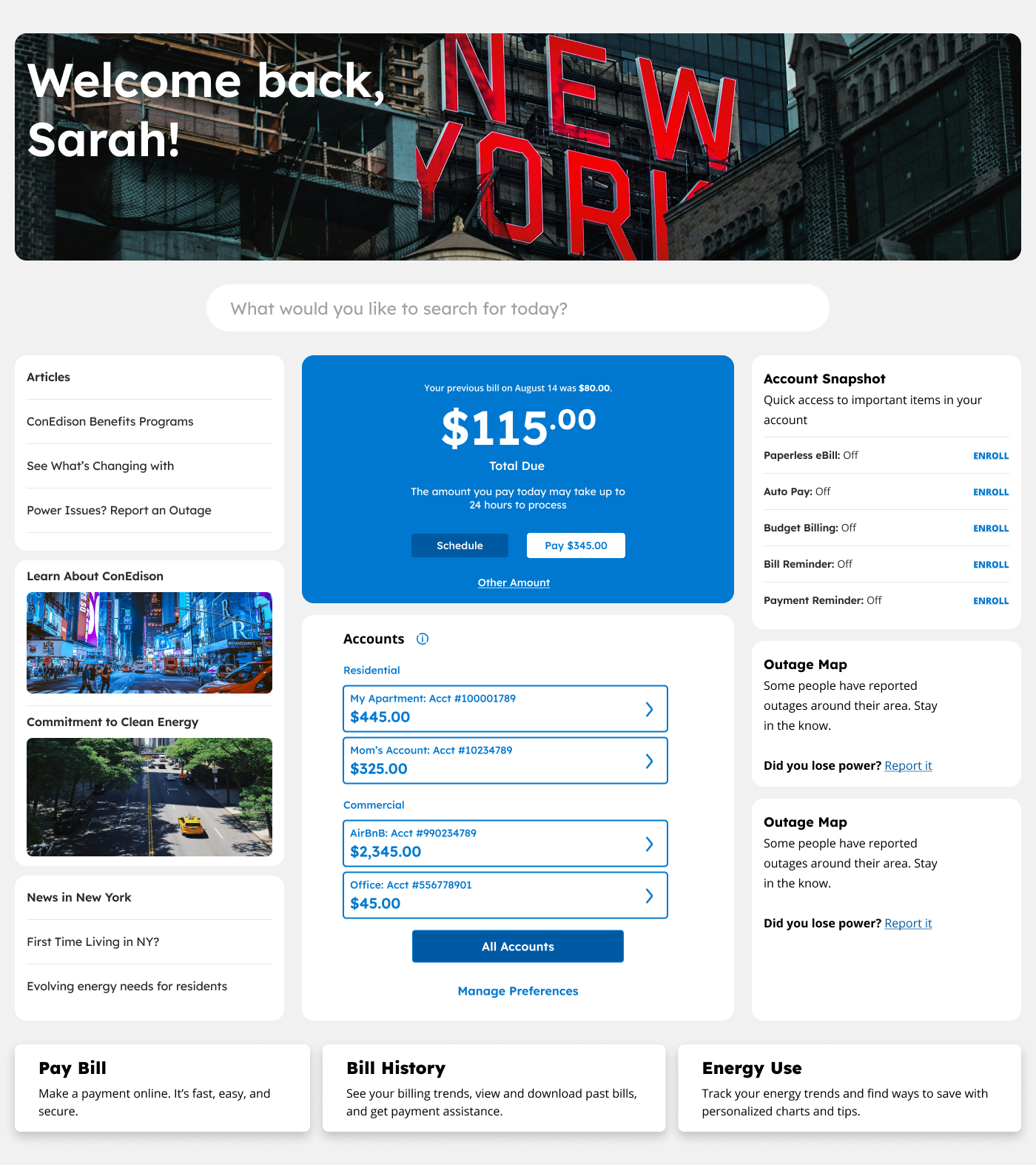
ConEdison customer portal: Customer Billing pod, managing multiple accounts, payment flows, and account snapshot modules
Leadership Context
Managing at Every Level
Two pods. One design direction. Zero ambiguity.
Managing two Agile pods simultaneously means holding design coherence across parallel workstreams that often pull in different directions. Customer Billing and Account Management share a platform but diverge in complexity, data density, and stakeholder pressure. My role is to make sure both move with intention.
Day to day that means working across the full org chart, managing stakeholder expectations through prototyping and presentations, facilitating collaborative UX discovery sessions, and navigating the competing constraints of legal, copy, frontend, backend, and Scrum Masters without losing design quality in the process.
- Lead design strategy and feature-level UX discovery sessions across both pods
- Manage stakeholder expectations through high-fidelity prototypes and executive presentations
- Partner with Legal and Content teams to ensure copy, compliance, and design are aligned before engineering picks up a ticket
- Collaborate with Creative Directors at VML and ConEdison to maintain brand voice and visual consistency
- Mentor designers on the pod: critique structure, career growth, and raising the quality floor
Two Agile pods, Customer Billing and Account Management, operating in parallel under a unified design direction
"Stakeholder alignment at an enterprise like ConEdison isn't a meeting; it's a practice. Prototypes do the talking that slide decks can't."
AI Integration
AI in design isn't about replacing judgment. It's about compressing the distance between an idea and a testable prototype.
Workflow Integration
Embedding AI at every stage of the design process
I introduced AI tooling into the design workflow incrementally, starting with the highest-friction areas and building team confidence before expanding. The goal wasn't adoption for its own sake; it was measurable speed and quality improvements that both design and engineering could feel.
- Prompt-driven wireframe divergence to explore 4–6 layout directions in the time it previously took to produce one
- AI-assisted copy generation paired directly with content designers for faster UX copy iteration
- Generative component variants in Figma to stress-test design system edge cases before engineering encounters them
- AI-supported accessibility checks integrated into the review workflow, catching contrast, label, and focus order issues before handoff
- Prototype acceleration using Framer and AI-enhanced interaction patterns to demonstrate complex behaviors to stakeholders without engineering investment
AI-assisted wireframe exploration: multiple directions generated and evaluated before any high-fidelity work begins
Lunch & Learns + Coaching
Raising AI literacy across two organizations
I run regular Lunch & Learn sessions for both the VML and ConEdison teams, design and engineering, demonstrating practical AI integrations with live tooling. These sessions aren't theoretical; they're hands-on demos that teams can walk away and apply the same day.
One-on-one coaching focuses on building critical judgment: when to use AI output as a starting point, when to reject it entirely, and how to review AI-generated content with the same rigour as any other design decision. The aim is a team that uses AI confidently, not blindly.
- Live demo sessions covering Figma AI features, AI-aided prototyping, and prompt engineering for design
- Tailored coaching for designers at different comfort levels, from skeptics to early adopters
- Engineering-focused sessions on design-to-code handoff improvements enabled by AI tooling
- Documented AI usage guidelines and decision frameworks shared with both organizations
Cross-functional AI sessions, bridging design and engineering teams at VML and ConEdison
Design System & Accessibility
Design System
A living system that engineering actually uses
Building and maintaining the ConEdison design system requires holding two things in tension: the creative flexibility teams need to solve real product problems, and the structural consistency that makes a platform serving millions of customers predictable and trustworthy.
I maintain the Figma component library with a token-based architecture (primitives → semantic → component) that maps directly to the frontend implementation, reducing the translation layer between design and code and making brand guideline updates propagate automatically across all surfaces.
- Token-based Figma system: primitives → semantic → component, mirroring the CSS token structure used in production
- Component documentation with usage guidelines, state specifications, and explicit do/don'ts for engineers and designers
- Brand guideline stewardship, maintaining ConEdison's visual identity across web portal, mobile web, and tablet breakpoints
- Design system contribution model: clear criteria for extending vs. creating new components, preventing fragmentation across pods
ConEdison design system: token architecture mapped to production CSS, maintained across two pod workstreams
WCAG 2.1 AA Compliance
Accessibility as infrastructure, not a checklist
ConEdison serves all of New York, which means the platform must work for users who are elderly, visually impaired, or operating under stress during an outage or billing dispute. Accessibility isn't an audit item at the end of a sprint; it's a design constraint from the first wireframe.
I built WCAG 2.1 AA compliance into the design system itself: contrast tokens, focus order documentation, accessible form patterns, and screen reader annotation standards, so that every component engineers pull from the library starts from a compliant baseline.
- WCAG 2.1 AA contrast ratios enforced at the token level; no component ships with a failing color pair
- Focus management and keyboard navigation patterns documented and tested across critical flows (payment, account management, outage reporting)
- Screen reader annotation layer in Figma: every handoff includes ARIA labels, landmark structure, and reading order
- Accessibility review integrated into the sprint definition of done, not a separate QA pass
WCAG compliance built in at the token level: color, contrast, and focus patterns enforced across every component
"When accessibility is in the token, it's in every component that inherits it. You fix it once. It propagates everywhere."
2
Agile pods led simultaneously: Customer Billing and Account Management
22%
Improvement in core task-completion rates across platform redesign initiatives
18%
Reduction in user drop-off following platform-wide navigation and IA redesign
AA
WCAG 2.1 AA compliance built into every component in the design system from day one
What I Learned
Reflection
AI adoption is a leadership problem before it's a tooling problem
The technology is the easy part. Getting a team of designers and engineers to shift how they work, especially in a regulated, enterprise environment with legacy process inertia, requires sustained investment in trust, demonstration, and psychological safety.
The Lunch & Learns that landed weren't the ones with the most impressive demos. They were the ones where I solved a real problem the team had that week, live, using AI. That's the proof of concept that changes behavior. Design leadership in an AI era isn't about knowing the most tools; it's about knowing which tool to reach for, and making that judgment legible enough that your team can replicate it.
Ongoing: this engagement continues to evolve as AI tooling and team capability compound

Get in Touch
Like what
you see?
Let's talk about your next project.